
Disclosure: This site contains affiliate links. If you click and sign up or make a purchase, I may receive a commission or referral bonus at no extra cost to you. I only recommend tools and resources that I believe add value to the ‘Snowball’ journey.
Today I wanted to talk about something that I think isn’t in the minds of many people in the work force. The true cost to an employer when hiring an employee.
Many people understand that they have Social Security, Medicare, State, and Federal taxes taken out of their paychecks. Medical benefit premiums and other benefits such as 401ks. What is usually not seen is the amount of money their employer pays on their behalf.
First, there is the employer portion of FICA (Social Security and Medicare). This is equal to the 7.65% that the employee pays. FUTA (Federal Unemployment Tax) this tax is 6% of the first $7,000 in wages per employee ($420), but since SUTA (State Unemployment) is also mandatory there is a federal credit. The credit reduces this down to 0.06% making the cost for most employers $42 per employee.
For SUTA we’ll use two examples. Ohio, and Washington State. Washington has the highest SUTA. Though many states can charge less if a business has low turnover, we’ll stick with the basic math. Washington can charge 6% on the first $70,000 in salary, capping at $4,200. Ohio can go as high as 9.8% but only on the first $9,000 of wages capping at $882.
Workers’ compensation insurance is another mandatory benefit to be paid per employee. Washington charges this based on hours worked, but can make their employee pay 25% of the cost. Average is $1.37 per week per worker. Ohio is $0.68 per $100 of payroll, but employer pays 100%.
According to several studies (Referenced here), most employers pay 83% of insurance premium costs. We’ll round that down to 80% for our math later. The article says the average cost of a single person plan was $8,000, leaving $1,600 to the employee and $6,400 to the employer. A family plan was $22,500, that’s $18,000 for the employer, and $4,500 for the employee.
The 401k matching and benefits can entail a bunch of expenses I won’t go into today because we’re focused on 1 employee out of potentially dozens or hundreds. The most common 401k match is 4%. As I believe I mentioned in the 401k articles this is based on your salary, not the “contribution limit.”
Lastly, before we get to the math, we have PTO. Looks like the standard is 2 weeks per year or maybe that’s the national average. That’s probably more 10 days over 14 so let’s keep it simple with 10. This is 10 days of your “daily rate” that an employer will have to pay you even if you don’t utilize the time off. If you quit with a 10 day balance they are required to pay that out to you. Which means it’s 10 more days of salary every year.
Below we’re going to break down two salaries. $50,000 and $100,000. I think it’s fair to use both Single and Family medical costs with both, but also be aware there are dozens of other costs a business has related to each employee like computers, software licenses, administration of pay, benefits, etc.
| Employer Cost | $50,000 Salary | $100,000 Salary |
|---|---|---|
| FICA | $3,825 | $7,650 |
| FUTA | $42 | $42 |
| SUTA WA | $3,000 | $4,200 |
| SUTA OH | $882 | $882 |
| Workers’ Compensation WA | $53.42 | $53.42 |
| Workers’ Compensation OH | $340 | $680 |
| Medical Single | $6,400 | $6,400 |
| Medical Family | $18,000 | $18,000 |
| 401k Match | $2,000 | $4,000 |
| Paid Time Off | $1,923 | $3,846 |
Workers’ Comp WA was 75% of $1.37 a week. For PTO I took the annual salary, divided by 52 for the weekly pay, divided by 5 for the daily pay. $50k was $192.30/day. $100k was $384.62
| Employer Total | $50,000 Salary | $100,000 Salary |
|---|---|---|
| Total Single WA | $17,243.42 | $26,191.42 |
| Total Single OH | $15,125 | $23,500 |
| Total Family WA | $28,843.42 | $37,791.42 |
| Total Family OH | $26,725 | $35,100 |
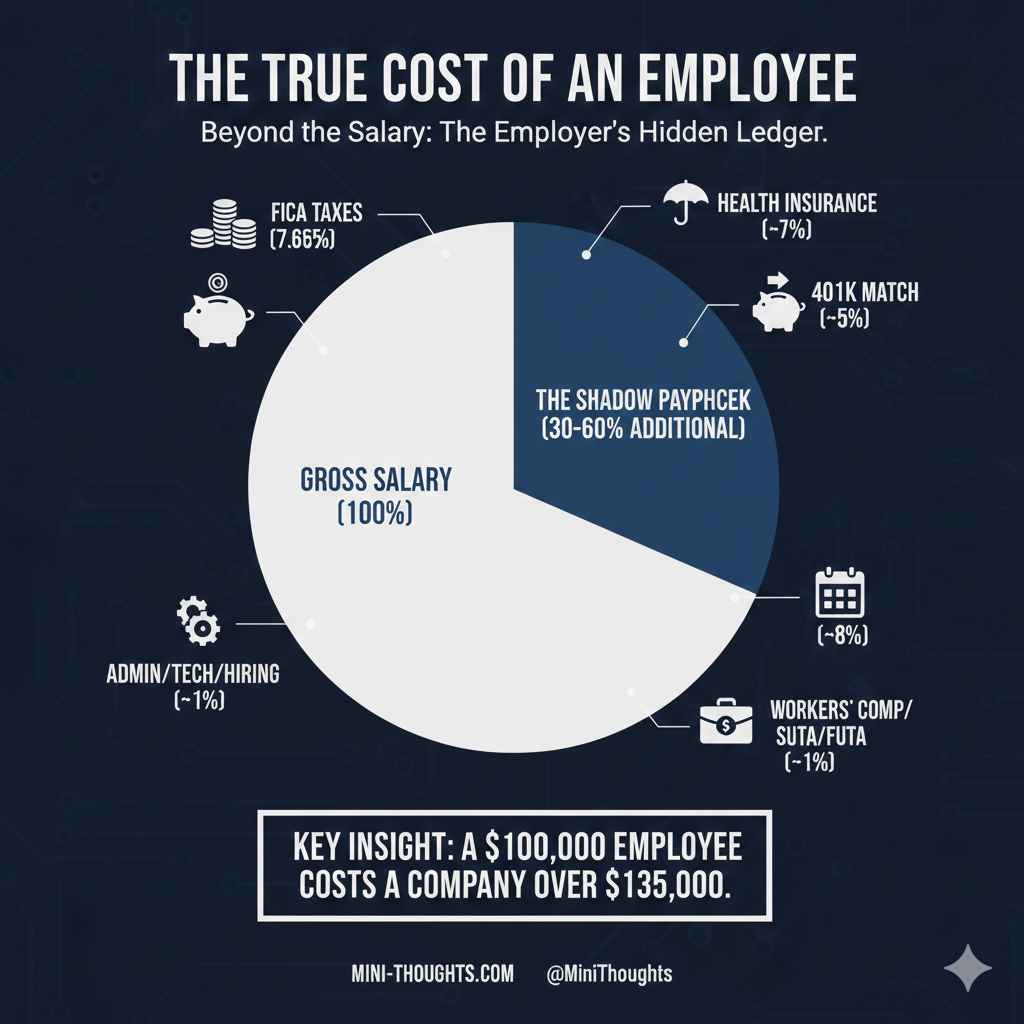
At the peak an employer is looking at a $50,000 employee salary costing the business almost $29,000 more in benefits. That’s 57% of the salary or a total of $78,843. The low end is $65,125 which is still 30% on top of that salary.
For the $100,000 salary, we peak at $137,791 for 38% more in costs. The lowest end is only $123,500 with a 23.5% increase cost to the employer.
I find a lot of good, but a lot of confusing information on X and I think this is something everyone needs to realize is happening on the back-end of their employment.
~~Miniwing~~
Parent, Stoic, Investor